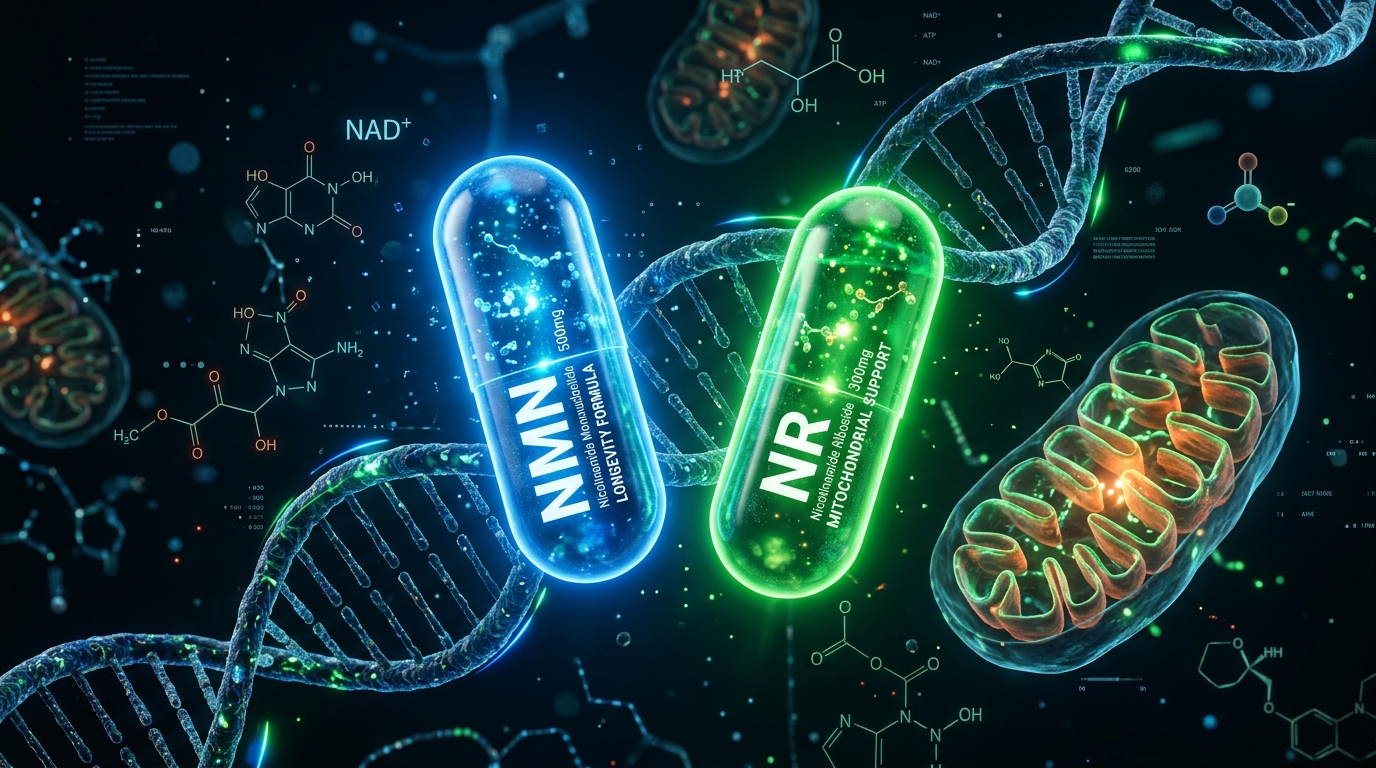
NAD+ (nicotinamide adenine dinucleotide) is one of the most critical molecules in your body. It fuels mitochondrial energy production, activates DNA repair enzymes called sirtuins, and regulates your circadian rhythm. The problem? NAD+ levels decline steadily with age — by as much as 50% between the ages of 40 and 60.
This has made NAD+ supplementation one of the hottest topics in longevity science. And the two leading precursors are NMN (nicotinamide mononucleotide) and NR (nicotinamide riboside). But which one actually works better?
What Is NMN?
NMN is a direct precursor to NAD+. It sits just one enzymatic step away from becoming NAD+ in your cells. Your body naturally produces NMN from B vitamins, but production slows with age.
How NMN Is Absorbed
For years, scientists debated whether NMN could be absorbed intact or needed to be converted to NR first. Research has since identified a specific transporter protein called Slc12a8 that allows NMN to enter cells directly, particularly in the gut. This sodium-dependent transporter gives NMN a unique absorption pathway that NR does not share.
Newer formulations — including sublingual and liposomal NMN — appear to improve bioavailability even further, with some studies suggesting liposomal NMN can rival intravenous NAD+ delivery.
What Is NR?
NR (nicotinamide riboside) is another NAD+ precursor, but it requires an additional conversion step. NR is first converted to NMN by the enzyme NRK (nicotinamide riboside kinase), and then NMN is converted to NAD+.
How NR Is Absorbed
NR is absorbed through the gut and metabolized primarily in the liver. This hepatic first-pass metabolism may limit how much NR actually reaches cells in other tissues, which is one reason researchers have been exploring whether NMN’s direct transport pathway offers an advantage.
NR has been commercially available longer than NMN and has more completed human clinical trials, particularly under the brand name Niagen.
NMN vs NR: Head-to-Head Comparison
| Feature | NMN | NR |
|---|---|---|
| Steps to NAD+ | 1 step (NMN → NAD+) | 2 steps (NR → NMN → NAD+) |
| Direct Cell Transporter | Yes (Slc12a8) | No (must convert to NMN first) |
| NAD+ Increase (4 weeks) | ~35% at 500mg/day | ~22% at 500mg/day |
| Human Clinical Trials | Growing rapidly | More extensive |
| FDA Status | Supplement (varies by region) | Supplement (NDI approved) |
| Typical Dose | 250–1000 mg/day | 250–1000 mg/day |
| Primary Metabolism | Gut and systemic | Liver (first-pass) |
| Cost | $40–80/month | $30–60/month |
How Effectively Do They Raise NAD+?
Both NMN and NR reliably increase NAD+ levels in human studies. However, head-to-head data published in 2025 reveals some differences:
- Participants taking 500mg of NMN daily showed a 35% increase in whole-blood NAD+ levels after four weeks
- Those taking 500mg of NR daily showed a 22% increase over the same period
- Both groups showed improvements over placebo
That said, the clinical significance of this difference is still debated. Both supplements raise NAD+ meaningfully, and individual responses can vary based on genetics, gut health, and baseline NAD+ levels.
What Does the Latest Research Say?
NMN Research Highlights
- Multiple completed human trials confirm NMN safely raises NAD+ levels at doses up to 1,200mg/day
- A 2021 study published in Science showed NMN improved insulin sensitivity in prediabetic women
- A 2021 study demonstrated improved aerobic capacity in amateur runners
- A 2025 trial found oral NMN supplementation benefited hair health markers in middle-aged women
- Liposomal NMN formulations are showing enhanced bioavailability in recent studies
NR Research Highlights
- NR has a longer track record of human trials, with Niagen (the branded NR ingredient) holding NDI (New Dietary Ingredient) status
- A randomized controlled trial in older adults with mild cognitive impairment showed NR safely raised NAD+ levels
- A 2025 randomized controlled trial investigated NR for long-COVID recovery, examining effects on NAD+ levels and cognition
- NR has been studied for conditions including fatty liver disease, kidney health, and cardiovascular function
Safety and Side Effects
Both NMN and NR have strong safety profiles in clinical studies:
- NMN: No serious adverse effects reported at doses up to 1,200mg/day. Occasional mild digestive discomfort.
- NR: Similarly well-tolerated. Mild side effects can include nausea, headache, or digestive issues in some individuals.
Neither supplement has shown concerning interactions in healthy adults, but you should always consult your healthcare provider if you take medications, particularly those affecting liver function or metabolism.
Which One Should You Choose?
Choose NMN if:
- You want the most direct pathway to NAD+ (one conversion step)
- You prefer the newer research showing potentially higher NAD+ elevation
- You’re interested in sublingual or liposomal formulations for better absorption
- You want a supplement that may have better systemic distribution beyond the liver
Choose NR if:
- You value a longer track record of human clinical trials
- You want a supplement with FDA NDI recognition (Niagen)
- You prefer a more affordable option
- You want the form with more published data on specific health conditions
Can You Combine NMN and NR?
There is no established benefit to taking both NMN and NR simultaneously, since they both converge on the same NAD+ synthesis pathway. Choosing one or the other is sufficient. However, pairing either NAD+ precursor with complementary supplements — like Urolithin A for mitophagy or resveratrol for sirtuin activation — may provide synergistic benefits.
Frequently Asked Questions
How long does it take for NMN or NR to work?
Most people report feeling increased energy within 1–3 weeks. Measurable NAD+ increases can be detected in blood within days, but cellular-level benefits accumulate over weeks to months.
What is the best time to take NMN or NR?
Both are typically taken in the morning due to NAD+‘s role in circadian rhythm regulation and energy metabolism. Taking them later in the day may interfere with sleep for some individuals.
Does NMN or NR work better for anti-aging?
Both raise NAD+, which activates sirtuins and supports DNA repair — key anti-aging mechanisms. NMN may have a slight edge in NAD+ elevation, but long-term anti-aging outcomes haven’t been directly compared in clinical trials.
Are there any foods that contain NMN or NR?
NMN is found in small amounts in broccoli, avocado, cabbage, and edamame. NR is found in trace amounts in milk. However, dietary amounts are far below supplemental doses, so food sources alone are unlikely to meaningfully raise NAD+.
The Bottom Line
Both NMN and NR are legitimate NAD+ precursors backed by real science. NMN offers a more direct conversion pathway and emerging data suggests slightly higher NAD+ elevation, while NR has a more established clinical track record and broader regulatory recognition.
The best choice depends on your priorities: cutting-edge potential (NMN) vs. established safety data (NR). Either way, boosting NAD+ is one of the most evidence-backed strategies for supporting mitochondrial health and healthy aging.
This article is for informational purposes only and does not constitute medical advice. Always consult a healthcare professional before starting any supplement regimen.
Frequently Asked Questions
Q: Is NMN better than NR for NAD+ levels? Human studies suggest NMN may raise blood NAD+ slightly more than NR, though both are effective. NMN has a more direct conversion pathway, while NR has more published clinical trials. Neither is definitively “better” — individual response varies.
Q: Can I take NMN and NR together? There is no evidence that combining NMN and NR provides additional benefit over taking either alone. They use overlapping pathways, so combining them is likely redundant and unnecessarily expensive.
Q: How long does it take for NMN or NR to work? Most studies show measurable increases in blood NAD+ within 1–2 weeks. Subjective benefits (energy, sleep quality) are typically reported after 4–8 weeks of consistent use.
Q: What is the best time to take NMN or NR? Most researchers recommend morning dosing, as NAD+ plays a role in circadian rhythm regulation. Taking it with or without food is generally fine, though taking with a small meal may reduce nausea in sensitive individuals.
Q: Are NMN and NR safe long-term? Both have good short-term safety profiles (up to 12 weeks in clinical trials). Long-term human safety data beyond 12 weeks is limited. No serious adverse events have been reported in published trials.
Related reading: NMN Dosage Guide by Age | NMN Side Effects: What Research Says | Best NMN Supplements in 2026 | How to Increase NAD+ Naturally
Sources:
- Yang, et al. (2025). An Updated Review on the Mechanisms, Pre-Clinical and Clinical Comparisons of NMN and NR. Food Frontiers.
- Yoshino, J., et al. (2021). Nicotinamide mononucleotide increases muscle insulin sensitivity in prediabetic women. Science, 372(6547), 1224-1229.
- Liao, B., et al. (2021). Nicotinamide mononucleotide supplementation enhances aerobic capacity in amateur runners. JISSN, 18(1), 54.
- Grozio, A., et al. (2019). Slc12a8 is a nicotinamide mononucleotide transporter. Nature Metabolism, 1(1), 47-57.