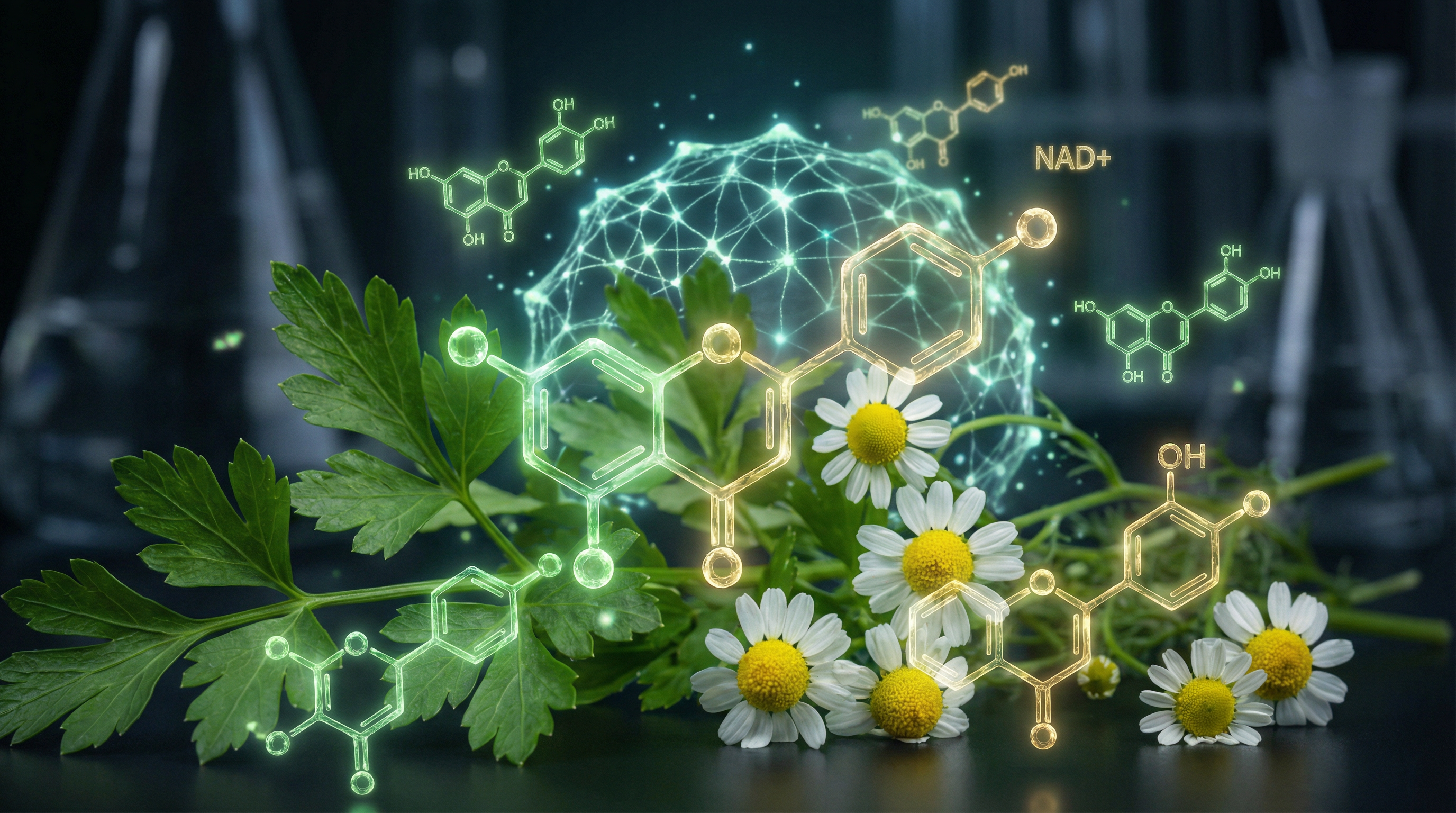
If you’ve spent any time researching NAD+ decline with age, you’ve probably learned a frustrating truth: your body doesn’t just produce less NAD+ as you get older — it also destroys it faster. The culprit is an enzyme called CD38, which ramps up dramatically with age and during chronic inflammation, chewing through NAD+ as one of its primary substrates.
That’s where apigenin enters the longevity conversation. This humble flavonoid, abundant in parsley, chamomile tea, and celery, happens to be one of the most potent natural CD38 inhibitors ever identified. For anyone already taking NMN or NR to raise NAD+, apigenin may be the missing piece that stops you from pouring water into a leaky bucket.
Here’s what the research says — and why apigenin has become a staple in serious longevity stacks.
What Is Apigenin?
Apigenin (4’,5,7-trihydroxyflavone) is a flavone — a subclass of flavonoids — found in a wide range of edible plants. It’s been studied for decades as an antioxidant and anti-inflammatory agent, but its role in NAD+ metabolism only became widely recognized after a landmark 2013 study by Anthony Sauve and colleagues identified it as a CD38 inhibitor capable of raising NAD+ levels in vivo.
Since then, apigenin has quietly earned a reputation as one of the few dietary compounds that directly influences the machinery of cellular aging.
Natural Sources of Apigenin
- Parsley — the richest dietary source, with up to 630 mg per 100 g of dried parsley
- Chamomile — the primary active flavonoid in chamomile tea
- Celery — leaves and seeds are especially concentrated
- Oregano, thyme, and rosemary — meaningful amounts in dried herbs
- Artichokes and red wine — modest contributions
- Oranges and grapefruit — small but bioavailable amounts
Even the richest food sources deliver only a few milligrams per serving, which is why supplementation has become the practical route for anyone seeking clinically meaningful doses.
How Apigenin Works: The CD38-NAD+ Connection
To understand why apigenin matters, you have to understand CD38. This enzyme sits on the surface of immune cells, endothelial cells, and many tissues throughout the body. Its job is to cleave NAD+ to produce signaling molecules like cyclic ADP-ribose.
The problem? CD38 is incredibly wasteful. It degrades around 100 molecules of NAD+ for every signaling molecule it generates. And CD38 expression increases roughly 3 to 5-fold in aging tissues, driven largely by chronic low-grade inflammation (what researchers call “inflammaging”).
The result: as you age, your cells simultaneously lose their ability to make NAD+ efficiently and suffer from an expanding fleet of CD38 enzymes stripping NAD+ out of every compartment.
Apigenin binds to CD38 and inhibits its activity. In a 2013 study published in Diabetes, mice given apigenin showed significantly elevated NAD+ levels in the liver, improved glucose tolerance, and reduced markers of metabolic inflammation. The researchers concluded that CD38 inhibition was the primary mechanism.
For anyone taking NMN or NR as NAD+ precursors, this is huge. Raising the supply of NAD+ precursors means little if CD38 degrades the resulting NAD+ faster than you can make it. Apigenin addresses the demolition side of the equation.
Key Health Benefits of Apigenin
1. Preserves Cellular NAD+ Pools
By blocking CD38, apigenin helps maintain higher steady-state NAD+ concentrations in aging tissues. Animal studies show apigenin supplementation can increase liver and muscle NAD+ by 20 to 40 percent, depending on dose and baseline status. This is especially relevant for people over 40, when CD38 activity has typically risen sharply.
2. Anti-Inflammatory Effects
Apigenin is one of the most studied natural anti-inflammatory flavonoids. It inhibits NF-kB signaling, suppresses the production of pro-inflammatory cytokines like TNF-alpha and IL-6, and modulates COX-2 activity. Since inflammaging is a major driver of CD38 upregulation in the first place, apigenin tackles the problem from both ends — reducing the inflammatory signals that recruit CD38 and directly inhibiting the enzyme itself.
3. Sleep and Anxiety Support
Apigenin binds to benzodiazepine receptors in the brain, producing a mild anxiolytic effect without sedation. This is why chamomile tea has been used for centuries as a sleep aid. Modern research confirms that apigenin can reduce sleep latency and improve sleep quality, making it a quiet complement to magnesium glycinate for sleep and longevity.
4. Cardiovascular Protection
Several studies show apigenin improves endothelial function, reduces oxidative stress in blood vessels, and helps regulate blood pressure. A 2019 meta-analysis of animal studies found consistent improvements in vascular reactivity and reductions in atherosclerotic plaque formation.
5. Potential Senolytic Activity
Early research suggests apigenin may have mild senolytic properties — meaning it can help clear senescent “zombie” cells that accumulate with age and secrete inflammatory factors. While less potent than dedicated senolytics like fisetin or quercetin, apigenin’s dual role as CD38 inhibitor and gentle senolytic makes it a useful addition to any longevity protocol.
6. Neuroprotective Effects
Apigenin crosses the blood-brain barrier and has demonstrated neuroprotective effects in models of Alzheimer’s disease, Parkinson’s disease, and ischemic stroke. It appears to reduce amyloid-beta toxicity, protect dopaminergic neurons, and enhance brain-derived neurotrophic factor (BDNF) signaling.
Apigenin Dosage Guide
Clinical studies on apigenin supplementation in humans are still limited, but the following dosing guidance reflects current research and common practice in the longevity community.
| Goal | Dose | Timing |
|---|---|---|
| General longevity / CD38 inhibition | 50 mg per day | Morning with food |
| Sleep and anxiety support | 50–100 mg | 30–60 minutes before bed |
| Anti-inflammatory / cardiovascular | 100–200 mg per day | Split dose with meals |
| Senolytic protocol (intermittent) | 200–400 mg | 2 consecutive days, every 2 weeks |
Important notes:
- Doses less than 50 mg from food alone are unlikely to significantly affect CD38 activity.
- Apigenin is fat-soluble; taking it with a meal containing healthy fats improves absorption.
- Bioavailability is a known limitation — liposomal or phytosome formulations can increase absorption 3 to 5-fold compared to standard powder.
How to Stack Apigenin with Other Longevity Supplements
Apigenin is most valuable as part of a comprehensive NAD+ protocol rather than a standalone. Here’s how it fits into a well-designed stack.
With NMN or NR
This is the most logical pairing. NMN or NR raises NAD+ synthesis while apigenin blocks CD38-mediated degradation. Think of it as filling the bucket faster while also patching the leak. Many longevity practitioners consider this combination synergistic and take 500–1000 mg of NMN alongside 50 mg of apigenin each morning.
With Quercetin and Fisetin
Apigenin has structural and functional similarities to quercetin and fisetin, but each flavonoid has a distinct target profile. Using all three provides broader coverage across CD38 inhibition, senolytic activity, and anti-inflammatory effects. See our comparison of quercetin vs fisetin for senolytic use for protocol guidance.
With a Complete Longevity Stack
Apigenin slots naturally into a foundational longevity supplement stack for beginners alongside NMN, resveratrol, omega-3s, and magnesium glycinate. The typical daily protocol looks something like: NMN in the morning, apigenin with breakfast or dinner, magnesium glycinate at night.
Safety Profile and Precautions
Apigenin is widely consumed in normal diets and has a long history of use in chamomile tea. Supplemental doses up to 400 mg per day appear well tolerated in short-term studies, with no major adverse effects reported.
Precautions to be aware of:
- Drug interactions — Apigenin inhibits CYP3A4 and CYP2C9 enzymes at high doses, which could affect medications metabolized by these pathways (including some blood thinners, statins, and immunosuppressants). If you take prescription medications, check with your physician before starting supplementation.
- Pregnancy and breastfeeding — Safety data at supplemental doses is limited. Food-level intake is considered safe, but supplementation should be avoided.
- Ragweed allergies — Apigenin derived from chamomile may trigger reactions in people with severe ragweed or daisy family allergies.
- Thyroid considerations — Very high doses of apigenin may have weak anti-thyroid effects in animal models. People with existing thyroid conditions should use moderate doses.
Frequently Asked Questions
Can I get enough apigenin from food?
Probably not for CD38 inhibition. A cup of chamomile tea contains around 5 mg of apigenin, and a tablespoon of dried parsley around 10 mg. Clinical benefits for NAD+ preservation generally require 50 mg or more, which is difficult to reach through diet alone.
Does apigenin actually raise NAD+ in humans?
Animal studies consistently show NAD+ increases of 20 to 40 percent with apigenin supplementation. Human data is still sparse, but a small 2022 pilot trial found that combining apigenin with NMN produced larger NAD+ increases than NMN alone. More robust human trials are ongoing.
Should I take apigenin in the morning or at night?
Both work, but the answer depends on your goal. For CD38 inhibition and metabolic benefits, morning with breakfast is ideal. For sleep support and anxiolytic effects, take it 30 to 60 minutes before bed. Some people split the dose.
Is apigenin the same as quercetin?
No. Both are flavonoids with overlapping benefits, but they have different molecular structures and target profiles. Apigenin is a stronger CD38 inhibitor, while quercetin has broader antioxidant activity and a stronger senolytic profile. They work well together in a stack.
How long until I notice effects from apigenin?
Anti-inflammatory and sleep benefits are often noticeable within 1 to 2 weeks. NAD+ preservation effects are cumulative and not directly “felt” — they show up as better energy, metabolic markers, and long-term resilience over months rather than days.
The Bottom Line
Apigenin is one of the few naturally occurring compounds with a clear, mechanistically grounded case for protecting NAD+ levels as you age. Its role as a CD38 inhibitor addresses the often-overlooked demolition side of NAD+ metabolism, making it a logical complement to NMN, NR, or any precursor-based protocol.
If you’re already optimizing NAD+ with NMN, NR, or natural approaches, adding 50 mg of apigenin daily is a low-cost, well-tolerated upgrade with meaningful upside. It won’t replace the core drivers of healthy aging — sleep, exercise, protein, and a smart supplement foundation — but it fills a gap that few other compounds address.
For longevity enthusiasts who want every NAD+ molecule to last as long as possible, apigenin deserves a permanent spot in the stack.