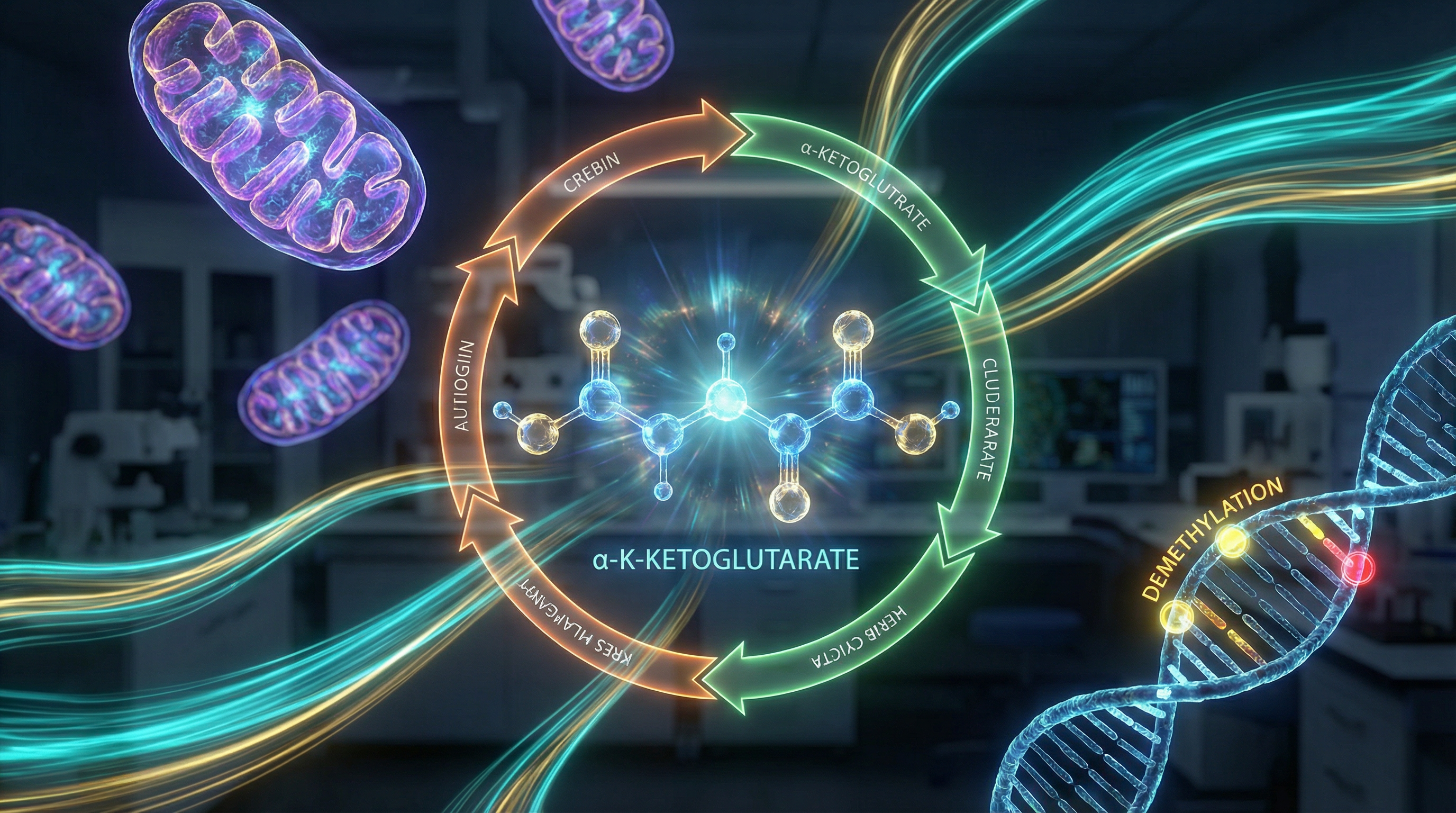
What if one of the most promising anti-aging compounds wasn’t a cutting-edge pharmaceutical — but a metabolite your body already produces? Calcium alpha-ketoglutarate (Ca-AKG) sits at the crossroads of energy metabolism, epigenetic regulation, and cellular rejuvenation. In landmark studies, it has extended lifespan in model organisms and reduced biological age in humans by an average of eight years. For anyone serious about longevity, Ca-AKG deserves a close look.
What Is Alpha-Ketoglutarate?
Alpha-ketoglutarate (AKG) is a naturally occurring organic acid and a key intermediate in the Krebs cycle — the metabolic engine inside every mitochondrion. Your cells use AKG to generate ATP, synthesize amino acids, and regulate nitrogen balance. As a cofactor for a family of enzymes called 2-oxoglutarate-dependent dioxygenases, AKG also plays critical roles in collagen synthesis, hypoxia signaling, and — most relevant to aging — epigenetic regulation through DNA and histone demethylation.
The “calcium” in Ca-AKG simply refers to the mineral salt form used in supplements, which improves stability and bioavailability compared to free AKG.
Endogenous AKG levels decline significantly with age. Plasma concentrations in older adults can be up to ten times lower than in young adults, mirroring the age-related decline seen in NAD+ levels. This parallel decline has led researchers to investigate whether restoring AKG could slow or reverse aspects of biological aging.
How Ca-AKG Works: Mechanisms of Action
Epigenetic Rejuvenation via TET Enzymes
One of the most exciting mechanisms involves the ten-eleven translocation (TET) family of enzymes. These enzymes require AKG as a cofactor to demethylate DNA — specifically, to convert 5-methylcytosine (5mC) to 5-hydroxymethylcytosine (5hmC). This process is essential for maintaining youthful gene expression patterns.
As AKG levels fall with age, TET enzyme activity drops, DNA hypermethylation accumulates, and epigenetic clocks accelerate. Supplementing with Ca-AKG restores TET activity, effectively helping cells maintain a younger epigenetic profile.
Mitochondrial Energy Production
As a direct Krebs cycle intermediate, supplemental AKG feeds into mitochondrial energy production. It is converted to succinyl-CoA, generating GTP and feeding electrons into the electron transport chain. This can boost ATP output in aging mitochondria that are struggling with reduced substrate availability — complementing strategies like mitochondrial supplement stacking.
AMPK Activation and mTOR Modulation
AKG activates AMP-activated protein kinase (AMPK), the master energy sensor that promotes autophagy, mitochondrial biogenesis, and stress resistance. Simultaneously, AKG has been shown to inhibit ATP synthase and mTOR signaling in certain contexts, mimicking the pro-longevity effects of caloric restriction without the need to reduce food intake.
Collagen and Tissue Integrity
AKG serves as a cofactor for prolyl hydroxylases, enzymes essential for collagen maturation. This means Ca-AKG supplementation may support connective tissue integrity, wound healing, and skin elasticity — visible markers of biological youth.
Key Health Benefits of Ca-AKG
Lifespan Extension in Animal Models
The foundational evidence comes from a 2020 study published in Cell Metabolism by Asadi Shahmirzadi et al. at the Buck Institute for Research on Aging. Mice receiving Ca-AKG from middle age showed:
- Median lifespan extension of 12% in females
- Reduced frailty scores across multiple organ systems
- Improved fur quality, fewer tumors, and preserved spinal curvature
- Compressed morbidity, meaning the mice stayed healthier for longer before decline
The fact that supplementation started at middle age — not from birth — makes this particularly relevant for human application. You don’t need to have been taking Ca-AKG your entire life to benefit.
Biological Age Reversal in Humans
The most striking human evidence comes from the Rejuvant study (Demidenko et al., 2021), published in Aging. In this open-label trial, 42 subjects taking a Ca-AKG-based supplement called Rejuvant for approximately seven months showed:
- Average biological age reduction of 8 years as measured by the TruMe epigenetic clock
- Effects were more pronounced in older participants and in those with higher chronological ages
- Women showed a biological age reversal of up to 10 years on average
While this study had limitations — it was open-label, lacked a placebo arm, and used a proprietary epigenetic clock — the magnitude of the results was remarkable and spurred larger follow-up trials now underway.
Bone and Muscle Health
AKG plays a role in bone metabolism through its influence on collagen synthesis and osteoblast activity. Animal studies show that AKG supplementation can increase bone mineral density and reduce age-related bone loss. Combined with its role in amino acid metabolism, Ca-AKG may help preserve the musculoskeletal system during aging — an effect that stacks well with creatine supplementation.
Immune Function and Inflammation
AKG has demonstrated immunomodulatory effects in multiple contexts. It can reduce inflammatory cytokine production, support T-cell metabolism, and enhance macrophage function. In the aging immune system — where chronic low-grade inflammation (“inflammaging”) is a hallmark — AKG’s anti-inflammatory properties may help restore balanced immune responses.
Gut Health and Intestinal Integrity
Research in animal models shows AKG supports intestinal barrier function and enterocyte energy metabolism. The gut lining is one of the most metabolically active tissues in the body, and AKG provides direct fuel for intestinal cells while supporting tight junction integrity.
Dosage Guide
| Population | Daily Dose | Timing | Notes |
|---|---|---|---|
| Adults under 40 (preventive) | 500–1,000 mg | Morning, with food | Lower dose may suffice for younger individuals |
| Adults 40–60 | 1,000–1,500 mg | Morning, with food | Aligns with Rejuvant study dosing |
| Adults over 60 | 1,000–2,000 mg | Split AM/PM, with food | Higher dose may compensate for greater AKG depletion |
| Athletes / high activity | 1,000–2,000 mg | Pre-workout or morning | Supports mitochondrial energy output |
Most clinical research has used doses in the 1,000 mg per day range. The calcium component contributes roughly 200 mg of elemental calcium per 1,000 mg of Ca-AKG, which should be factored into total daily calcium intake.
Stacking Ca-AKG With Other Longevity Supplements
Ca-AKG works through distinct but complementary pathways compared to other longevity compounds, making it an excellent addition to a comprehensive protocol.
Ca-AKG + NMN/NR: While NMN and NR boost NAD+ directly, Ca-AKG works upstream on epigenetic maintenance and Krebs cycle efficiency. Together, they address both the energy and epigenetic axes of aging.
Ca-AKG + Resveratrol/Pterostilbene: Sirtuin activators like resveratrol need NAD+ to function. Ca-AKG supports the metabolic environment in which sirtuins operate, creating synergy between epigenetic rejuvenation and sirtuin-driven DNA repair.
Ca-AKG + Senolytics (Fisetin/Quercetin): Ca-AKG rejuvenates existing cells while senolytics clear damaged ones. This two-pronged approach addresses cellular aging from both angles.
Ca-AKG + Spermidine: Both promote autophagy through different mechanisms. Spermidine induces autophagy directly, while Ca-AKG supports it through AMPK activation and improved mitochondrial signaling.
Safety Profile and Precautions
Ca-AKG has an excellent safety profile. Alpha-ketoglutarate is an endogenous metabolite, and the body has robust mechanisms for handling it. In clinical studies, no serious adverse events have been attributed to Ca-AKG supplementation at standard doses.
Common considerations:
- Gastrointestinal: Some users report mild stomach discomfort when taking Ca-AKG on an empty stomach. Taking it with food typically resolves this.
- Calcium content: Each 1,000 mg of Ca-AKG provides roughly 200 mg of calcium. Individuals already supplementing calcium or with hypercalcemia risk should account for this.
- Blood sugar: AKG may influence glucose metabolism. Those on diabetes medications should monitor blood sugar when starting supplementation.
- Kidney stones: Individuals with a history of calcium oxalate kidney stones should consult their physician before adding a calcium-containing supplement.
- Pregnancy and breastfeeding: Insufficient data exists for these populations. Consult a healthcare provider.
Drug interactions: No significant drug interactions have been reported in the literature, but as with any supplement, inform your physician if you take prescription medications.
Frequently Asked Questions
Is Ca-AKG the same as regular AKG?
Chemically, the AKG portion is identical. The “calcium” refers to the mineral salt form, where AKG is bound to calcium ions. This form is more stable for supplementation and provides better bioavailability than free alpha-ketoglutarate. Other salt forms like sodium AKG and ornithine AKG exist but are less studied for longevity applications.
How long does it take to see results from Ca-AKG?
The Rejuvant study showed measurable biological age changes after approximately seven months. However, subjective benefits like improved energy and better recovery may appear within weeks. Epigenetic changes take time to accumulate, so consistent long-term use is key.
Can I get AKG from food instead of supplements?
Your body produces AKG endogenously as part of normal metabolism. Certain foods contain small amounts — particularly fermented foods and some fruits — but the quantities are far below supplemental doses. There is no practical way to achieve therapeutic levels (1,000 mg or more daily) through diet alone.
Does Ca-AKG interact with NMN or other NAD+ boosters?
No negative interactions have been reported. In fact, the mechanisms are complementary. NMN raises NAD+ levels directly, while Ca-AKG supports epigenetic maintenance and mitochondrial metabolism through distinct pathways. Many longevity researchers take both as part of a comprehensive supplement stack.
Is Ca-AKG safe for long-term use?
Current evidence suggests yes. AKG is a natural metabolite that your body produces and uses continuously. The Rejuvant study participants took it for seven months with no safety concerns. However, multi-year human safety data from controlled trials is still limited, and longer studies are ongoing.
The Bottom Line
Calcium alpha-ketoglutarate represents one of the most compelling longevity interventions to emerge in recent years. Its ability to influence epigenetic age — the most accurate molecular measure of biological aging we have — sets it apart from supplements that target only one pathway. By feeding into mitochondrial energy production, activating AMPK, supporting TET-mediated epigenetic maintenance, and promoting collagen integrity, Ca-AKG addresses aging on multiple fronts simultaneously.
The science is still maturing. Larger, placebo-controlled human trials are needed to confirm the dramatic biological age reversal seen in the initial Rejuvant study. But the safety profile is reassuring, the mechanistic rationale is strong, and the animal data is robust. For those building a serious longevity supplement protocol, Ca-AKG earns a place on the shortlist — particularly for individuals over 40 looking to address the metabolic and epigenetic drift that accelerates with age.