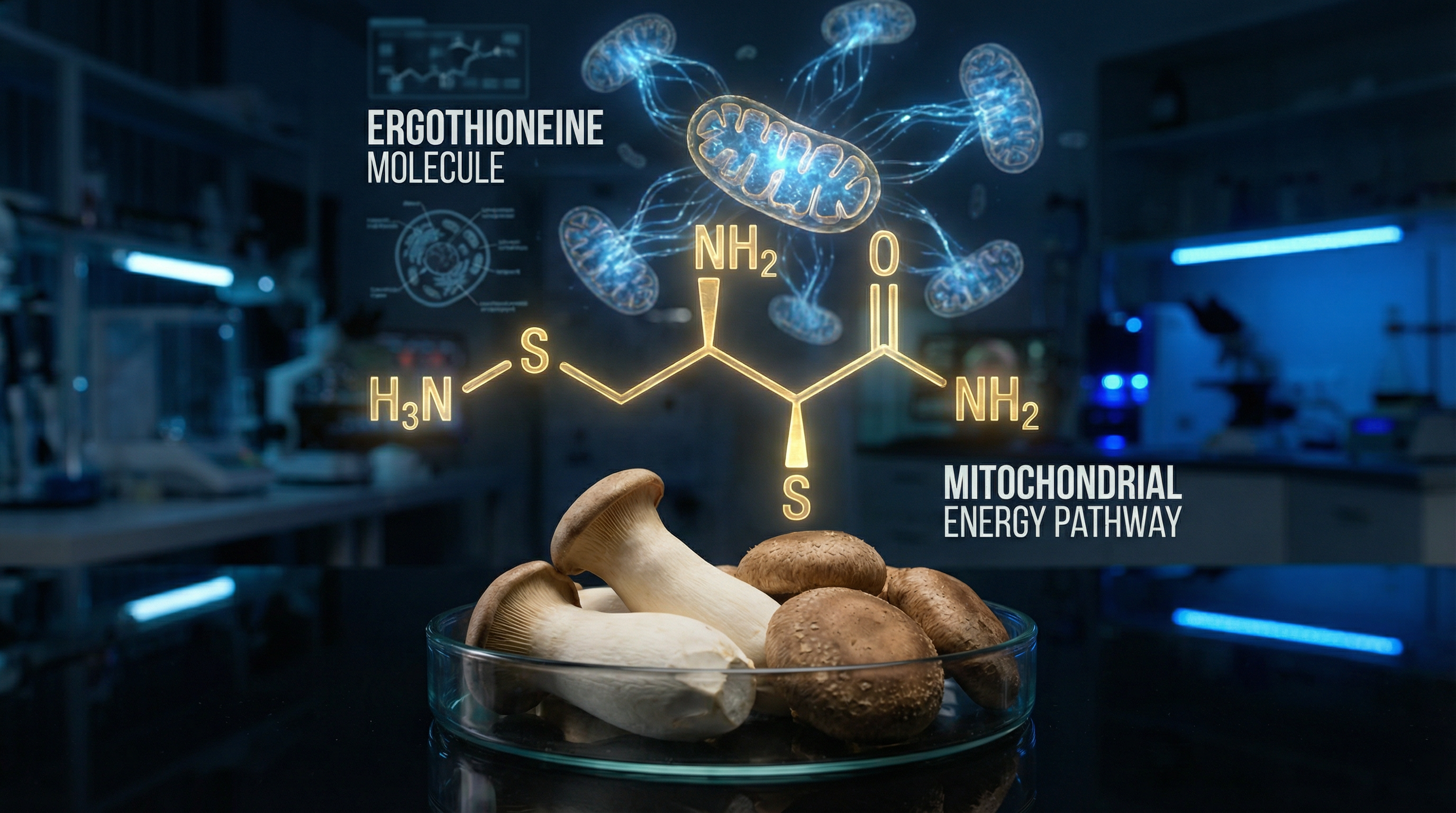
Your body has a dedicated transporter protein whose sole purpose is to absorb a single amino acid from your diet — one found primarily in mushrooms. That molecule is ergothioneine, and the fact that we evolved specialized cellular machinery just to hold onto it tells researchers something profound: this compound is essential for human longevity.
In 2005, scientists discovered OCTN1 (SLC22A4), a transporter that actively accumulates ergothioneine in cells exposed to the highest oxidative stress — the brain, heart, liver, kidneys, and eyes. Since then, a growing body of evidence has linked low ergothioneine levels to accelerated aging, cognitive decline, and increased all-cause mortality. Some researchers now argue it deserves classification as a vitamin — the “longevity vitamin.”
What Is Ergothioneine?
Ergothioneine (abbreviated EGT or ERGO) is a sulfur-containing amino acid first isolated from ergot fungus in 1909. Unlike most antioxidants your body produces internally, humans cannot synthesize ergothioneine — we must obtain it entirely from food or supplementation.
The richest dietary sources are fungi. Mushrooms like king oyster, porcini, shiitake, and lion’s mane contain the highest concentrations, typically ranging from 1 to 13 mg per gram of dry weight. Smaller amounts appear in black beans, red beans, oat bran, and certain organ meats, but mushrooms remain the dominant source by a wide margin.
What makes ergothioneine unusual among antioxidants is its remarkable stability. While glutathione, vitamin C, and other antioxidants degrade quickly under heat and light, ergothioneine resists degradation even at cooking temperatures. It also accumulates in tissues over time rather than being rapidly excreted, suggesting your body treats it as a precious resource worth conserving.
How Ergothioneine Works: Mechanism of Action
Ergothioneine operates through several interconnected pathways that collectively protect cells from age-related damage.
Mitochondrial Protection
Ergothioneine concentrates heavily in mitochondria, where it neutralizes reactive oxygen species (ROS) generated during energy production. Unlike conventional antioxidants that can become pro-oxidant at high doses, ergothioneine maintains its protective function across a wide concentration range. It specifically scavenges hydroxyl radicals, peroxynitrite, and hypochlorous acid — some of the most damaging free radicals produced during mitochondrial dysfunction.
Metal Ion Chelation
Free iron and copper ions catalyze Fenton reactions that generate destructive hydroxyl radicals. Ergothioneine chelates these metal ions, preventing them from triggering oxidative cascading. This is particularly relevant in aging tissue where iron accumulation is increasingly recognized as a driver of cellular damage.
DNA and Protein Shielding
Research shows ergothioneine protects both nuclear and mitochondrial DNA from oxidative lesions. It also prevents protein carbonylation — the irreversible oxidative modification of proteins that accumulates with age and impairs cellular function.
Anti-Inflammatory Signaling
Ergothioneine suppresses NF-kB activation and reduces pro-inflammatory cytokines including IL-6 and TNF-alpha. Chronic low-grade inflammation (inflammaging) is a hallmark of biological aging, making this property especially valuable for longevity.
Key Health Benefits of Ergothioneine
Brain Health and Neuroprotection
The brain accumulates more ergothioneine than almost any other tissue, and for good reason. A landmark 2019 study published in Biochemical and Biophysical Research Communications found that low plasma ergothioneine levels predicted cognitive decline in elderly subjects over a follow-up period.
The Singapore Longitudinal Ageing Study tracked over 470 elderly adults and found that those with the lowest blood ergothioneine levels had significantly greater risk of developing mild cognitive impairment. Subsequent research has shown ergothioneine crosses the blood-brain barrier, reduces beta-amyloid toxicity, and protects dopaminergic neurons — the cells that degenerate in Parkinson’s disease.
For those already supporting brain health with compounds like lion’s mane mushroom, ergothioneine may offer complementary neuroprotection through distinct mechanisms.
Cardiovascular Protection
A 2020 study in the Journal of the American Heart Association analyzed data from over 3,200 participants in the PREDIMED trial and found that higher plasma ergothioneine was associated with reduced risk of coronary heart disease, cardiovascular mortality, and all-cause mortality. The association remained significant even after adjusting for traditional cardiovascular risk factors.
Ergothioneine protects endothelial cells lining blood vessels from oxidative damage, inhibits LDL oxidation (a key step in atherosclerosis), and reduces platelet aggregation. These effects position it as a broad-spectrum cardiovascular protector.
Longevity and All-Cause Mortality
Perhaps the most compelling evidence comes from population studies linking ergothioneine to lifespan. A 2021 metabolomics analysis published in Free Radical Biology and Medicine identified ergothioneine as one of a small set of metabolites most strongly associated with healthy aging. Countries with higher average mushroom consumption — notably Japan, Italy, and Singapore — tend to have longer-lived populations, though this is observational.
Animal studies paint a more mechanistic picture. In C. elegans models, ergothioneine supplementation extended lifespan by approximately 16%. In fruit flies, it improved stress resistance and delayed age-related decline. While human longevity trials are still underway, the convergence of epidemiological and animal data is striking.
Liver and Kidney Protection
Both the liver and kidneys accumulate high concentrations of ergothioneine via the OCTN1 transporter. Animal studies demonstrate that ergothioneine pretreatment significantly reduces liver fibrosis, drug-induced hepatotoxicity, and kidney damage from ischemia-reperfusion injury. These organs face constant oxidative stress from their filtration and detoxification roles, making targeted antioxidant protection particularly valuable.
Eye Health
Ergothioneine accumulates in the lens and retina, where it may protect against cataracts and age-related macular degeneration. A 2022 study in Antioxidants showed ergothioneine prevented oxidative damage to lens epithelial cells and reduced markers of cataract formation in animal models.
Ergothioneine Dosage Guide
| Population | Daily Dose | Notes |
|---|---|---|
| General wellness | 5-10 mg | Equivalent to roughly 100g of mushrooms daily |
| Active longevity support | 10-25 mg | Most clinical research uses this range |
| Targeted neuroprotection | 25-30 mg | Higher doses studied for cognitive endpoints |
| From diet alone | 1-5 mg | Typical Western diet provides minimal amounts |
Most ergothioneine supplements are available in 5 mg or 10 mg capsules, often derived from fermentation using Mycobacterium smegmatis or extracted from mushroom biomass. The compound is well-absorbed orally due to the OCTN1 transporter in the gut, with bioavailability estimated at over 90%.
There is no established upper limit, as toxicity studies in animals have shown no adverse effects at doses hundreds of times higher than typical supplemental doses. However, more is not necessarily better — ergothioneine accumulates in tissues over weeks, so consistent daily dosing is more important than taking large single doses.
Stacking Ergothioneine With Other Supplements
Ergothioneine pairs exceptionally well with other longevity-focused compounds due to its unique mechanism of action.
Ergothioneine + NMN or NR: Ergothioneine protects the mitochondria that NAD+ boosters are trying to energize. Think of it as shielding the engine while NMN fuels it. This is a logical foundational stack for anyone focused on mitochondrial longevity.
Ergothioneine + Sulforaphane: Both activate the Nrf2 antioxidant pathway but through complementary mechanisms. Sulforaphane induces endogenous antioxidant production while ergothioneine provides direct ROS scavenging.
Ergothioneine + PQQ + CoQ10: A comprehensive mitochondrial support stack covering biogenesis (PQQ), electron transport (CoQ10), and oxidative protection (ergothioneine).
Ergothioneine + Lion’s Mane: Dual neuroprotection — lion’s mane stimulates nerve growth factor (NGF) production while ergothioneine shields neurons from oxidative damage.
Safety Profile and Precautions
Ergothioneine has an excellent safety record. Key points:
- Generally Recognized as Safe (GRAS): The FDA granted GRAS status to ergothioneine in 2018, affirming its safety for use in food and supplements.
- No known drug interactions: Unlike some antioxidants that interfere with chemotherapy or blood thinners, ergothioneine has no documented clinically significant drug interactions.
- Well-tolerated: Clinical trials report no significant adverse effects at doses up to 25 mg daily over extended periods.
- Pregnancy and breastfeeding: Insufficient safety data exists for these populations. Consult your healthcare provider before supplementing.
- OCTN1 polymorphisms: Rare genetic variants in the OCTN1 transporter may affect absorption. If you notice no benefit after several months of consistent dosing, genetic variation in transport efficiency could be a factor.
One nuance worth noting: because ergothioneine is a potent scavenger of hypochlorous acid (produced by immune cells to kill pathogens), there is a theoretical concern that very high doses could modestly suppress innate immune killing. This has not been observed in practice at supplemental doses but is worth monitoring in future research.
Frequently Asked Questions
Can I get enough ergothioneine from diet alone?
It depends on your mushroom intake. Eating 100-200 grams of mushrooms (particularly king oyster, porcini, or shiitake) three to four times per week can provide meaningful ergothioneine levels. However, the typical Western diet provides only 1-3 mg daily, well below the 10-25 mg range used in longevity research. Supplementation bridges this gap efficiently.
How long does ergothioneine take to work?
Because ergothioneine accumulates in tissues over time, most researchers suggest allowing 4-8 weeks of consistent daily supplementation before assessing benefits. Blood levels rise within days, but tissue saturation — where the real protective effects occur — takes longer.
Is ergothioneine better than glutathione as an antioxidant?
They serve different roles. Glutathione is your primary intracellular antioxidant and detoxification molecule. Ergothioneine is a targeted mitochondrial protector with superior stability and unique metal-chelating properties. They complement rather than replace each other. Taking both is a reasonable strategy.
Does cooking destroy ergothioneine in mushrooms?
No — this is one of ergothioneine’s most impressive properties. Unlike vitamin C or many polyphenols, ergothioneine is heat-stable and survives normal cooking temperatures. Sauteing, grilling, or adding mushrooms to soups retains most of their ergothioneine content.
Who should consider supplementing with ergothioneine?
Anyone over 40 with limited mushroom intake would be a reasonable candidate, given declining antioxidant defenses with age. It is particularly worth considering for those focused on brain health, cardiovascular protection, or building a comprehensive mitochondrial support stack alongside supplements like NMN, CoQ10, and PQQ.
The Bottom Line
Ergothioneine stands out in the crowded antioxidant landscape for several reasons: your body evolved a dedicated transporter to absorb it, it concentrates precisely where oxidative damage is greatest, and population-level data consistently links higher levels to longer, healthier lives. While it may not yet carry an official vitamin classification, the evidence increasingly supports treating it as an essential nutrient for longevity.
For those already building a science-backed supplement regimen, ergothioneine fills a critical niche — direct mitochondrial antioxidant protection — that other popular longevity compounds don’t fully address. Combined with NAD+ boosters, mitophagy activators, and a nutrient-dense diet rich in mushrooms, it represents another powerful tool in the quest to age well.