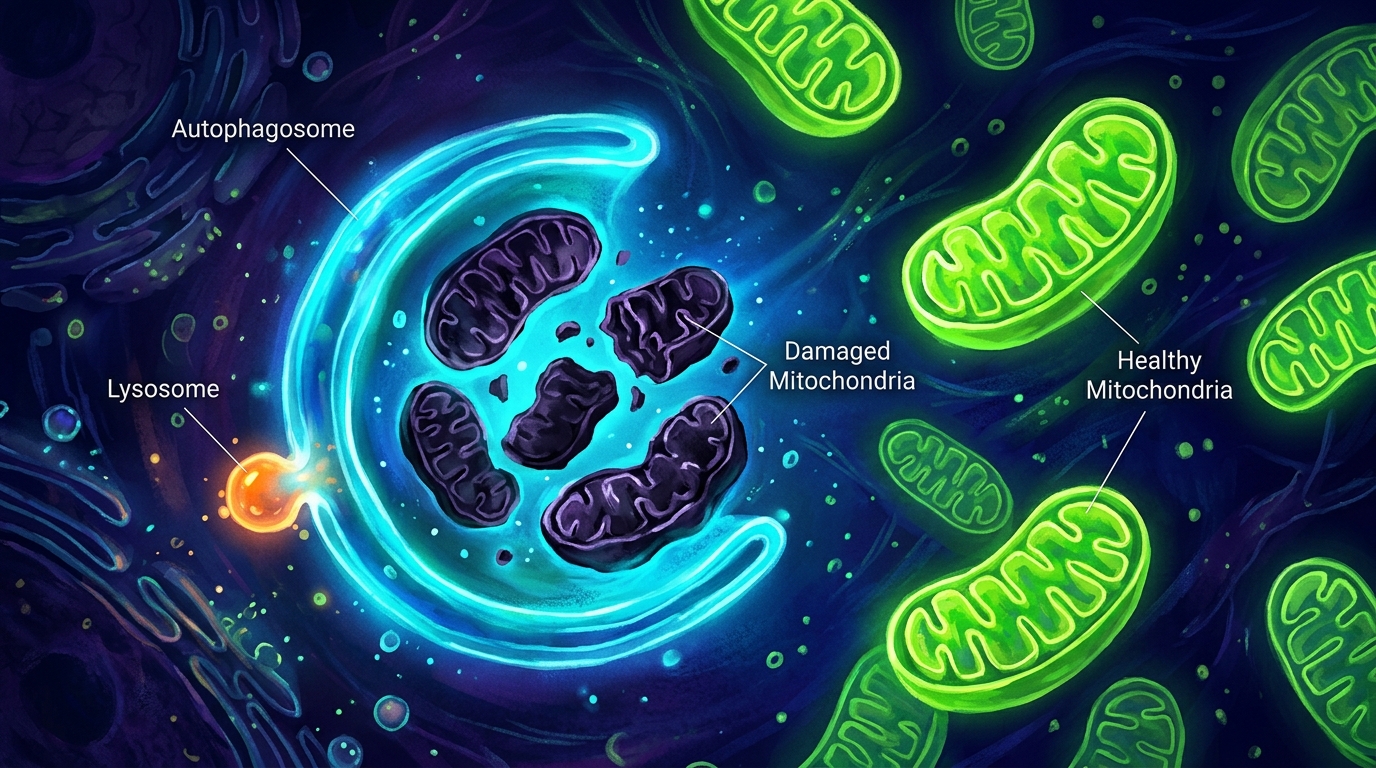
Your body has a remarkable built-in quality control system for mitochondria: mitophagy.
When mitochondria become damaged or dysfunctional, mitophagy tags them for destruction and recycles their components. The result is a cleaner, more efficient mitochondrial population.
The problem? Mitophagy declines significantly with aging — leaving damaged mitochondria to accumulate, drive inflammation, and accelerate cellular aging.
Activating mitophagy is one of the most mechanistically sound longevity strategies available.
What Is Mitophagy?
Mitophagy is a selective form of autophagy — the cellular “self-eating” process — specifically targeting damaged or dysfunctional mitochondria.
The process:
- Damaged mitochondria lose membrane potential
- PINK1 protein accumulates on the outer mitochondrial membrane
- PINK1 recruits Parkin, which tags the mitochondria with ubiquitin chains
- Autophagosome engulfs the tagged mitochondria
- Lysosome fuses and degrades the contents
- Cellular components are recycled
This quality control prevents accumulation of mitochondria that produce excess reactive oxygen species (ROS) and inflammatory signals.
Why Mitophagy Declines With Age
Multiple factors reduce mitophagy efficiency as we age:
- Reduced PINK1/Parkin pathway activity
- Lysosomal dysfunction (the “recycling center” becomes less efficient)
- Accumulation of protein aggregates that interfere with autophagic machinery
- Reduced NAD+ levels (NAD+ activates sirtuins that regulate autophagy)
- mTOR hyperactivation (mTOR inhibits autophagy)
The result: damaged mitochondria accumulate, generating more ROS, triggering inflammation, and contributing to the mitochondrial dysfunction seen in aging.
Signs That Your Mitophagy May Be Impaired
While there’s no simple consumer test for mitophagy activity, signs of impaired mitochondrial quality control include:
- Persistent fatigue and low energy
- Exercise intolerance
- Elevated inflammatory markers
- Slow muscle recovery
- Age-related mitochondrial decline symptoms (see our mitochondrial dysfunction guide)
How to Activate Mitophagy
1. Fasting and Caloric Restriction
Most powerful natural mitophagy activator.
Fasting activates mitophagy through multiple pathways:
- Reduces mTOR activity (mTOR inhibits autophagy)
- Activates AMPK (which promotes autophagy)
- Reduces NAD+ consumption, increasing availability for sirtuin activation
Fasting protocols for mitophagy:
| Protocol | Duration | Mitophagy Level |
|---|---|---|
| 16:8 intermittent fasting | 16h fast | Mild-moderate |
| 24-hour fast | 24h | Moderate-strong |
| 48-72 hour fast | 48-72h | Strong |
| 5:2 diet (2 days 500 kcal) | Ongoing | Moderate |
Significant mitophagy typically requires 16–18+ hours of fasting in most people.
2. Exercise
Exercise activates mitophagy through multiple mechanisms:
- AMPK activation during energy depletion
- PGC-1α activation (regulates mitochondrial biogenesis AND mitophagy)
- Mechanical stress triggers mitochondrial quality control
Most effective for mitophagy:
- Endurance exercise (45–60 min moderate-intensity)
- HIIT (alternating high/low intensity)
- Both are effective; consistency matters more than type
Combining exercise with fasting (fasted cardio) may amplify mitophagic effects.
3. Cold Exposure
Cold immersion activates the sympathetic nervous system, which:
- Increases norepinephrine (activates mitochondrial biogenesis and quality control)
- Activates AMPK
- May stimulate mitophagy in brown adipose tissue
Evidence: Mostly animal and in vitro. Human data on cold-induced mitophagy is limited but promising.
Practical application:
- Cold showers (2–5 min at ~60°F/15°C)
- Cold water immersion (10–15 min at 50–60°F)
4. Urolithin A — The Most Targeted Supplement
Urolithin A is the only supplement proven to activate mitophagy in human clinical trials.
A landmark 2019 study in Nature Metabolism found that urolithin A supplementation:
- Increased mitophagy markers in skeletal muscle
- Improved muscle endurance
- Enhanced mitochondrial gene expression
Dosage: 500–1,000mg/day Form: Mitopure® (the research-backed form used in clinical trials)
This makes urolithin A uniquely valuable for those who want targeted mitophagy support beyond lifestyle interventions.
5. NAD+ Precursors (NMN/NR)
NAD+ is essential for SIRT1 and SIRT3 activation. These sirtuins regulate autophagy and mitophagy through deacetylation of key pathway components.
As NAD+ declines with age, mitophagic capacity decreases. Restoring NAD+ levels with NMN or NR may restore mitophagy efficiency.
Dosage: NMN 250–500mg/day OR NR 300–500mg/day
6. Spermidine
Spermidine is a naturally occurring polyamine found in wheat germ, soybeans, and aged cheese. It’s one of the few compounds shown to activate autophagy and mitophagy in humans.
A 2018 observational study found higher dietary spermidine intake correlated with reduced cardiovascular mortality. A small clinical trial showed spermidine supplementation improved memory in older adults with subjective memory decline.
Dosage: 1–5mg/day from supplements Food sources: Wheat germ (~24mg/100g), soybeans (~20mg/100g), aged cheese
7. Rapamycin (Prescription Only)
Rapamycin (sirolimus) is the most potent mTOR inhibitor known, and mTOR inhibition powerfully activates autophagy/mitophagy.
It extends lifespan in every organism tested. Some longevity physicians prescribe it off-label for healthy aging at low intermittent doses (e.g., 5mg weekly).
Not for self-supplementation — it’s an immunosuppressant drug with significant potential side effects. Requires physician oversight.
8. Green Tea (EGCG)
EGCG, the primary catechin in green tea, activates AMPK and may stimulate mitophagy through Beclin-1 upregulation.
Evidence is mostly in vitro and animal studies. As a standalone mitophagy activator, evidence is modest.
Benefits at any dose: Anti-inflammatory, antioxidant — worth drinking 2–3 cups daily regardless.
Mitophagy Activation Stack
For those serious about mitophagy:
Daily:
- Urolithin A: 500–1,000mg
- NMN: 250–500mg
- Spermidine: 1–2mg
- Exercise: 30–60 min (any type)
Fasting:
- 16:8 intermittent fasting daily
- 24-hour fast once monthly
Periodic:
- Cold exposure 3–5x/week
- Longer (36–72h) fasts quarterly (consult physician)
Balancing Mitophagy With Mitochondrial Biogenesis
Mitophagy removes old mitochondria. Mitochondrial biogenesis creates new ones. Both are essential.
Mitophagy activators: Fasting, exercise, urolithin A, rapamycin Biogenesis activators: Exercise, NMN/NAD+, PQQ, cold exposure
The good news: exercise activates both processes simultaneously — which is why it’s so powerful for mitochondrial health.
The Bottom Line
Mitophagy is one of the most important but overlooked aspects of mitochondrial health. As it declines with age, damaged mitochondria accumulate and drive cellular aging.
The most accessible interventions — intermittent fasting + regular exercise — are also the most evidence-backed for activating mitophagy. Supplements like urolithin A and NMN provide additional targeted support.
Prioritize the lifestyle interventions first, then layer in supplements.
Related: Urolithin A: Benefits, Dosage & Research | Best Mitochondrial Supplement Stack