You sleep 8 hours but wake up exhausted. Your mind feels foggy by afternoon. Your muscles ache after minimal exertion. Standard blood tests come back normal.
If this sounds familiar, mitochondrial dysfunction may be contributing to your symptoms.
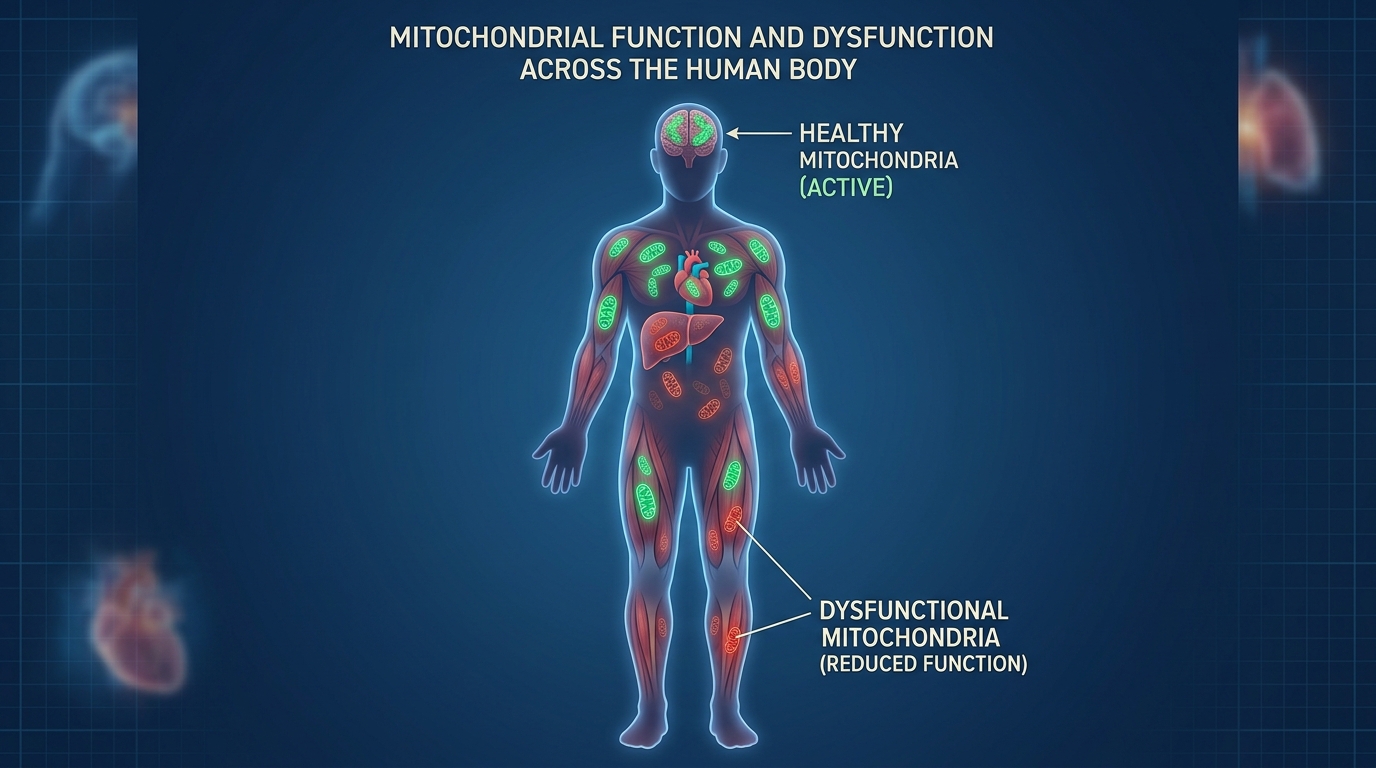
Mitochondria power 90% of cellular energy production. When they’re not working properly, every system in your body suffers — particularly those with high energy demands: the brain, heart, and muscles.
What Is Mitochondrial Dysfunction?
Mitochondrial dysfunction occurs when mitochondria fail to produce adequate ATP (cellular energy) efficiently. This can result from:
- Damaged mitochondrial DNA
- Impaired electron transport chain function
- Excessive oxidative stress within mitochondria
- Reduced mitochondrial number or density
- Impaired mitophagy (clearance of damaged mitochondria)
It exists on a spectrum from mild functional impairment (very common with aging) to severe primary mitochondrial diseases (rare genetic disorders).
This article focuses on acquired mitochondrial dysfunction — the common, functional decline seen with aging, poor lifestyle, and various health conditions — not rare genetic mitochondrial diseases.
Common Symptoms of Mitochondrial Dysfunction
Because mitochondria are everywhere, symptoms can affect multiple body systems:
Energy and Fatigue
- Persistent fatigue not relieved by rest
- Energy crashes, especially after meals or exertion
- Exercise intolerance — fatigue disproportionate to activity level
- “Post-exertional malaise” (feeling worse after activity)
Cognitive
- Brain fog, difficulty concentrating
- Memory problems
- Mental fatigue
- Word-finding difficulties
Muscular
- Muscle weakness
- Exercise-induced muscle pain
- Slow recovery after physical activity
- Reduced muscle endurance
Metabolic
- Unexplained weight changes
- Blood sugar dysregulation
- Increased sensitivity to temperature
Neurological
- Headaches and migraines
- Sleep disturbances
- Sensory disturbances (tingling, numbness)
Who Is at Risk?
Aging
Mitochondrial function declines with age. By 80, many tissues have 40–60% lower mitochondrial capacity than at age 25. This is a normal but significant change.
People with Certain Conditions
- Type 2 diabetes and insulin resistance
- Obesity
- Chronic fatigue syndrome (ME/CFS)
- Fibromyalgia
- Cardiovascular disease
- Neurodegenerative diseases (Parkinson’s, Alzheimer’s)
- Long COVID
Lifestyle Factors
- Chronic sleep deprivation
- Sedentary lifestyle
- Poor diet (ultra-processed food, nutrient deficiencies)
- Chronic stress
- Excessive alcohol consumption
- Smoking
Medications
Several common medications impair mitochondrial function:
- Statins — reduce CoQ10, which is essential for mitochondrial energy production
- Metformin — inhibits Complex I of the electron transport chain
- Some antibiotics (fluoroquinolones, tetracyclines) — damage mitochondrial DNA
- Acetaminophen (high doses) — depletes glutathione, increasing mitochondrial oxidative stress
How to Test for Mitochondrial Dysfunction
No single test definitively diagnoses functional mitochondrial dysfunction. A comprehensive assessment includes:
Blood Tests
- Lactate/pyruvate ratio — elevated in mitochondrial dysfunction
- CoQ10 levels — often low
- Organic acids (urine) — mitochondrial metabolites
- Amino acid profile — certain patterns suggest mitochondrial issues
- Carnitine levels — essential for mitochondrial fatty acid metabolism
Functional Tests
- VO2 max — reflects mitochondrial oxidative capacity
- Grip strength — simple proxy for mitochondrial muscle function
- 6-minute walk test — functional exercise capacity
Advanced/Research Tests
- Mitochondrial DNA copy number — reduced in dysfunction
- ATP production assay — measures actual ATP output (specialized labs)
- Muscle biopsy — gold standard for research, rarely needed clinically
Evidence-Based Solutions
1. Exercise — The Most Powerful Intervention
Exercise is the single most effective way to improve mitochondrial function. It works by:
- Stimulating mitochondrial biogenesis (creation of new mitochondria) via PGC-1α
- Increasing mitochondrial density in muscle
- Improving electron transport chain efficiency
- Stimulating mitophagy (removal of damaged mitochondria)
Best exercise types for mitochondrial health:
- High-intensity interval training (HIIT) — most potent stimulus for mitochondrial biogenesis
- Zone 2 cardio (conversational pace, 45–60 min) — builds mitochondrial endurance capacity
- Resistance training — maintains mitochondrial density in muscle
Target: 150+ minutes moderate activity OR 75+ minutes vigorous activity weekly, plus resistance training 2x/week.
2. Nutritional Interventions
Key nutrients for mitochondrial function:
| Nutrient | Role | Sources |
|---|---|---|
| CoQ10 | Electron transport chain | Organ meats, fatty fish, supplements |
| B vitamins (B1, B2, B3) | Mitochondrial enzymes | Whole grains, meat, legumes |
| Magnesium | 300+ enzymatic reactions | Nuts, seeds, leafy greens |
| Iron | Electron transport chain | Red meat, legumes |
| Alpha-lipoic acid | Antioxidant, cofactor | Organ meats, supplements |
| L-carnitine | Fatty acid transport | Red meat, supplements |
Dietary patterns that support mitochondrial health:
- Mediterranean diet — reduces oxidative stress
- Caloric restriction — stimulates mitophagy
- Time-restricted eating — promotes mitochondrial quality control
3. Key Supplements
Tier 1 (Strongest Evidence):
- CoQ10/Ubiquinol — 200–300mg/day; essential for electron transport chain
- Magnesium glycinate — 200–400mg/day; deficiency is extremely common
Tier 2 (Good Evidence):
- NMN or NR — 250–500mg/day; boosts NAD+, critical for mitochondrial function
- Alpha-lipoic acid (R-ALA) — 300–600mg/day; mitochondrial antioxidant
- L-carnitine — 500–2,000mg/day; transports fatty acids into mitochondria
Tier 3 (Emerging Evidence):
- PQQ — 20mg/day; stimulates mitochondrial biogenesis
- Urolithin A — 500–1,000mg/day; induces mitophagy
- Berberine — 500mg 2x/day; activates AMPK
4. Sleep Optimization
Mitochondrial repair and recycling occurs primarily during sleep. Chronic sleep deprivation directly impairs mitochondrial function.
- Target 7–9 hours quality sleep
- Maintain consistent sleep/wake times
- Reduce blue light 2 hours before bed
- Keep bedroom cool (65–68°F / 18–20°C)
5. Stress Reduction
Chronic psychological stress elevates cortisol, which:
- Increases mitochondrial oxidative stress
- Impairs mitochondrial membrane potential
- Reduces mitochondrial biogenesis
Mind-body practices with evidence: meditation, yoga, cold exposure (brief), breathwork.
6. Toxin Reduction
Minimize exposure to mitochondrial toxins:
- Avoid unnecessary medications that impair mitochondrial function
- Reduce alcohol consumption
- Avoid smoking and secondhand smoke
- Minimize exposure to pesticides and heavy metals (especially mercury)
When to See a Doctor
Seek medical evaluation if you have:
- Severe, debilitating fatigue not explained by lifestyle factors
- Progressive muscle weakness
- Neurological symptoms (vision changes, balance problems, seizures)
- Family history of mitochondrial disease
- Symptoms in multiple organ systems
A functional medicine physician or metabolic specialist can order appropriate testing and rule out treatable causes.
The Bottom Line
Mild mitochondrial dysfunction is extraordinarily common — it’s a fundamental aspect of aging and a consequence of modern lifestyles. The symptoms are often dismissed or attributed to other causes.
The good news: mitochondria are remarkably responsive to intervention. Exercise, nutrition optimization, targeted supplementation, and lifestyle changes can meaningfully restore mitochondrial function at any age.
Start with the fundamentals — exercise, sleep, diet — before adding supplements. The supplements support the foundation; they don’t replace it.
Related: Best Mitochondrial Supplement Stack | How to Increase NAD+ Levels Naturally