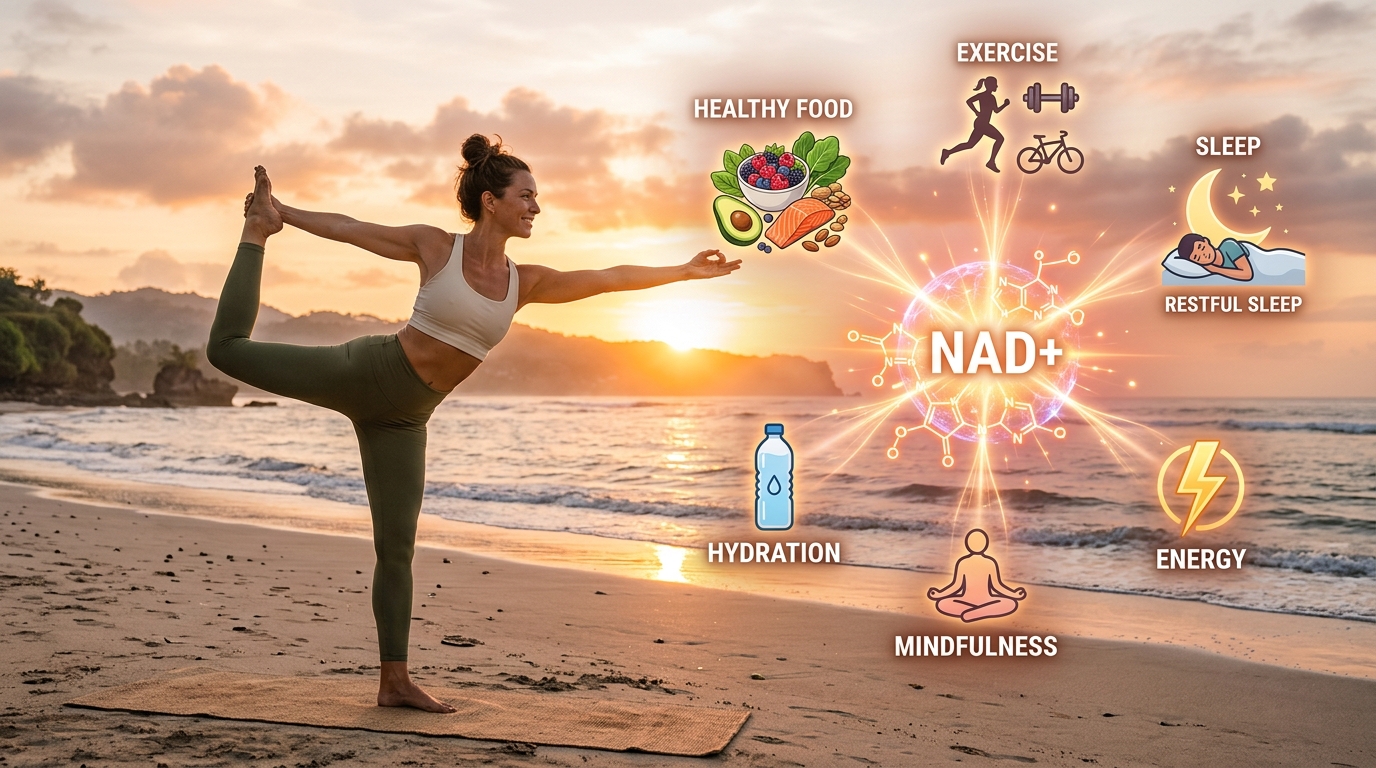
NAD+ (nicotinamide adenine dinucleotide) is essential for mitochondrial energy production, DNA repair, and cellular aging. While supplements like NMN and NR can effectively boost NAD+ levels, there are also powerful natural strategies that support NAD+ production — many of which are free.
Whether you want to maximize your NAD+ before adding supplements, or complement your existing supplement stack with lifestyle strategies, these eight methods are backed by research.
1. Exercise — The Most Powerful Natural NAD+ Booster
Exercise is the single most effective way to raise NAD+ without supplementation. Physical activity activates NAMPT (nicotinamide phosphoribosyltransferase), the rate-limiting enzyme in NAD+ biosynthesis.
What the Research Shows
- Aerobic exercise increases NAD+ levels in muscle tissue by activating AMPK and SIRT1 pathways
- Both endurance and resistance training stimulate mitochondrial biogenesis through PGC-1α activation
- Even moderate exercise (brisk walking) improves mitochondrial function in older adults
How to Apply It
- Minimum: 150 minutes of moderate aerobic activity per week
- Optimal: Combine cardio (3–4 sessions) with resistance training (2–3 sessions)
- High-impact option: HIIT (High-Intensity Interval Training) is particularly effective at stimulating mitochondrial adaptation
Exercise doesn’t just boost NAD+ — it also increases the number and quality of mitochondria, making it foundational to any longevity strategy.
2. Intermittent Fasting and Caloric Restriction
Fasting is one of the most well-studied NAD+ boosting strategies in longevity research. When your body enters a fasted state, it activates survival pathways that depend on NAD+.
The Mechanism
- Fasting activates AMPK (AMP-activated protein kinase), which upregulates NAMPT
- NAMPT increases NAD+ synthesis from nicotinamide
- Higher NAD+ activates sirtuins, which promote DNA repair, fat metabolism, and stress resistance
How to Apply It
- Time-restricted eating (16:8): Eat within an 8-hour window, fast for 16 hours. The simplest approach for most people.
- 24-hour fast: Once per week or biweekly for a more potent NAD+ boost
- Caloric restriction (10–20%): Even modest calorie reduction activates similar pathways without full fasting
Important: Fasting isn’t appropriate for everyone. Consult your doctor if you have diabetes, a history of eating disorders, or take medications that require food.
3. Optimize Your Sleep
NAD+ levels follow a circadian rhythm — they’re highest during waking hours and decline during sleep. Poor sleep disrupts this rhythm and can lead to chronically low NAD+.
What the Research Shows
- Disrupted circadian rhythms reduce NAMPT expression and NAD+ production
- Sleep deprivation impairs sirtuin activity, which depends on NAD+
- Shift workers and those with irregular sleep patterns show accelerated markers of cellular aging
How to Apply It
- Target 7–9 hours of quality sleep per night
- Consistent schedule: Go to bed and wake up at the same time daily
- Light exposure: Get bright light within 30 minutes of waking; avoid blue light 1–2 hours before bed
- Cool bedroom: Optimal sleep temperature is 65–68°F (18–20°C)
4. Eat NAD+ Precursor-Rich Foods
While dietary sources alone won’t replace supplementation, certain foods provide the building blocks your body needs to synthesize NAD+.
Foods High in NAD+ Precursors
Niacin (Vitamin B3) sources:
- Chicken breast, turkey
- Tuna, salmon
- Mushrooms
- Green peas
- Peanuts
Tryptophan sources (converts to NAD+ via the kynurenine pathway):
- Turkey, chicken
- Eggs
- Cheese
- Soybeans
NMN-containing foods (small amounts):
- Broccoli, cabbage
- Avocado
- Edamame
- Cucumber
Niacin-rich diet tip: A balanced diet providing the RDA of niacin (16mg/day for men, 14mg/day for women) supports baseline NAD+ production. However, food sources provide far less than supplemental doses. For a deeper dive on supplementation, see our NMN dosage guide.
5. Limit Alcohol Consumption
Alcohol is one of the most potent NAD+ depleting substances you can consume. When your liver metabolizes alcohol, it uses massive amounts of NAD+ in the process.
The Impact
- Alcohol metabolism by ADH and ALDH enzymes directly consumes NAD+
- Chronic alcohol use leads to persistent NAD+ depletion in the liver and brain
- Even moderate drinking (1–2 drinks daily) reduces NAD+ availability
- Alcohol disrupts sleep quality, creating a double hit to NAD+ levels
How to Apply It
- Best: Eliminate or minimize alcohol consumption
- Moderate approach: Limit to 1–2 drinks per week rather than per day
- After drinking: Prioritize sleep and hydration to support NAD+ recovery
6. Heat and Cold Exposure
Both heat stress (sauna) and cold stress activate cellular pathways that support NAD+ production and mitochondrial health.
Sauna / Heat Exposure
- Heat shock activates heat shock proteins (HSPs) and AMPK
- Regular sauna use (4+ sessions per week) is associated with reduced all-cause mortality in observational studies
- Temperature: 174–212°F (80–100°C) for 15–20 minutes
Cold Exposure
- Cold activates brown fat, which is rich in mitochondria
- Cold-induced norepinephrine release stimulates mitochondrial biogenesis via PGC-1α
- Methods: Cold showers (2–3 minutes), cold plunges (50–60°F / 10–15°C for 2–5 minutes)
Both heat and cold create mild cellular stress (hormesis) that triggers adaptive responses strengthening mitochondrial function.
7. Reduce Chronic Inflammation
Chronic inflammation is a major NAD+ drain. Inflammatory signaling activates CD38, an enzyme that degrades NAD+. In fact, CD38 activity is one of the primary reasons NAD+ declines with age.
Anti-Inflammatory Strategies
- Anti-inflammatory diet: Emphasize omega-3 fatty acids (fatty fish, walnuts, flaxseeds), colorful vegetables, and spices like turmeric and ginger
- Reduce processed food: Processed meats, refined sugars, and seed oils promote inflammation
- Manage stress: Chronic psychological stress drives inflammatory cytokine production
- Exercise regularly: Consistent exercise has potent anti-inflammatory effects
The CD38 Connection
Research shows that CD38 levels increase with age and are a major contributor to NAD+ decline. Some supplements — like apigenin (found in parsley and chamomile tea) — may help inhibit CD38, though human data is still limited.
8. Manage Stress with Mindfulness
Chronic stress doesn’t just feel bad — it actively depletes NAD+ through increased oxidative stress and inflammation.
The Pathway
- Chronic stress → elevated cortisol → increased oxidative stress → higher NAD+ consumption for repair
- Stress disrupts sleep → circadian NAD+ rhythm disrupted
- Stress increases inflammation → CD38 activity rises → more NAD+ degradation
Evidence-Based Stress Reduction
- Meditation: Even 10 minutes daily has measurable effects on stress biomarkers
- Deep breathing exercises: Activates the parasympathetic nervous system
- Time in nature: Reduces cortisol levels within 20 minutes
- Social connection: Strong social bonds are consistently linked to reduced inflammation and better health outcomes
Putting It All Together: A Daily NAD+ Optimization Protocol
| Time | Strategy |
|---|---|
| Morning | Bright light exposure within 30 min of waking |
| Morning | Exercise (alternate cardio and strength training) |
| Eating window | 16:8 intermittent fasting (e.g., 10am–6pm) |
| Meals | NAD+ precursor-rich foods (lean protein, veggies, nuts) |
| Afternoon | Cold shower or cold plunge (2–5 min) |
| Evening | Sauna session (2–3x per week, 15–20 min) |
| Evening | Stress reduction (meditation, reading, nature) |
| Night | Consistent bedtime, cool dark room, 7–9 hours sleep |
When Natural Strategies Aren’t Enough
Lifestyle approaches are powerful, but they have limits — especially as you age. If you’re over 40 and practicing these strategies but still experiencing declining energy, slow recovery, or cognitive fog, NMN or NR supplementation can provide a more direct NAD+ boost.
The best approach combines natural strategies with targeted supplementation. See our guides on NMN vs NR and NMN dosing by age for supplementation guidance.
Frequently Asked Questions
Can I raise NAD+ enough with just lifestyle changes?
For younger adults (under 40) with healthy habits, lifestyle strategies may be sufficient to maintain adequate NAD+. For older adults or those with significant NAD+ decline, supplementation likely provides additional benefits beyond what lifestyle alone can achieve.
How quickly do natural strategies raise NAD+?
Exercise can increase NAD+ in muscle tissue within a single session. However, sustained elevation requires consistent practice over weeks to months. Fasting can increase NAD+ within 12–24 hours.
Which strategy should I start with?
Exercise. It has the strongest evidence for NAD+ elevation and provides the broadest health benefits. Add sleep optimization second, then consider intermittent fasting.
Do these strategies work alongside NMN supplementation?
Absolutely. Natural strategies and supplementation are additive. Exercise, in particular, activates the same enzymes (NAMPT) that convert NMN to NAD+, potentially making supplementation more effective.
The Bottom Line
NAD+ optimization isn’t just about popping a supplement — it’s a lifestyle. Exercise, fasting, sleep, diet, and stress management all contribute to maintaining the NAD+ levels your mitochondria need to function optimally.
Start with the fundamentals, be consistent, and add supplementation when lifestyle alone isn’t meeting your goals. Your mitochondria will thank you.
This article is for informational purposes only and does not constitute medical advice. Always consult a healthcare professional before making significant changes to your diet, exercise, or supplement regimen.
Sources:
- Cantó, C., et al. (2012). The NAD+ precursor nicotinamide riboside enhances oxidative metabolism and protects against high-fat diet-induced obesity. Cell Metabolism, 15(6), 838-847.
- Imai, S., & Guarente, L. (2014). NAD+ and sirtuins in aging and disease. Trends in Cell Biology, 24(8), 464-471.
- Camacho-Pereira, J., et al. (2016). CD38 dictates age-related NAD decline and mitochondrial dysfunction. Cell Metabolism, 23(6), 1127-1139.
- Longo, V.D., & Panda, S. (2016). Fasting, circadian rhythms, and time-restricted feeding in healthy lifespan. Cell Metabolism, 23(6), 1048-1059.