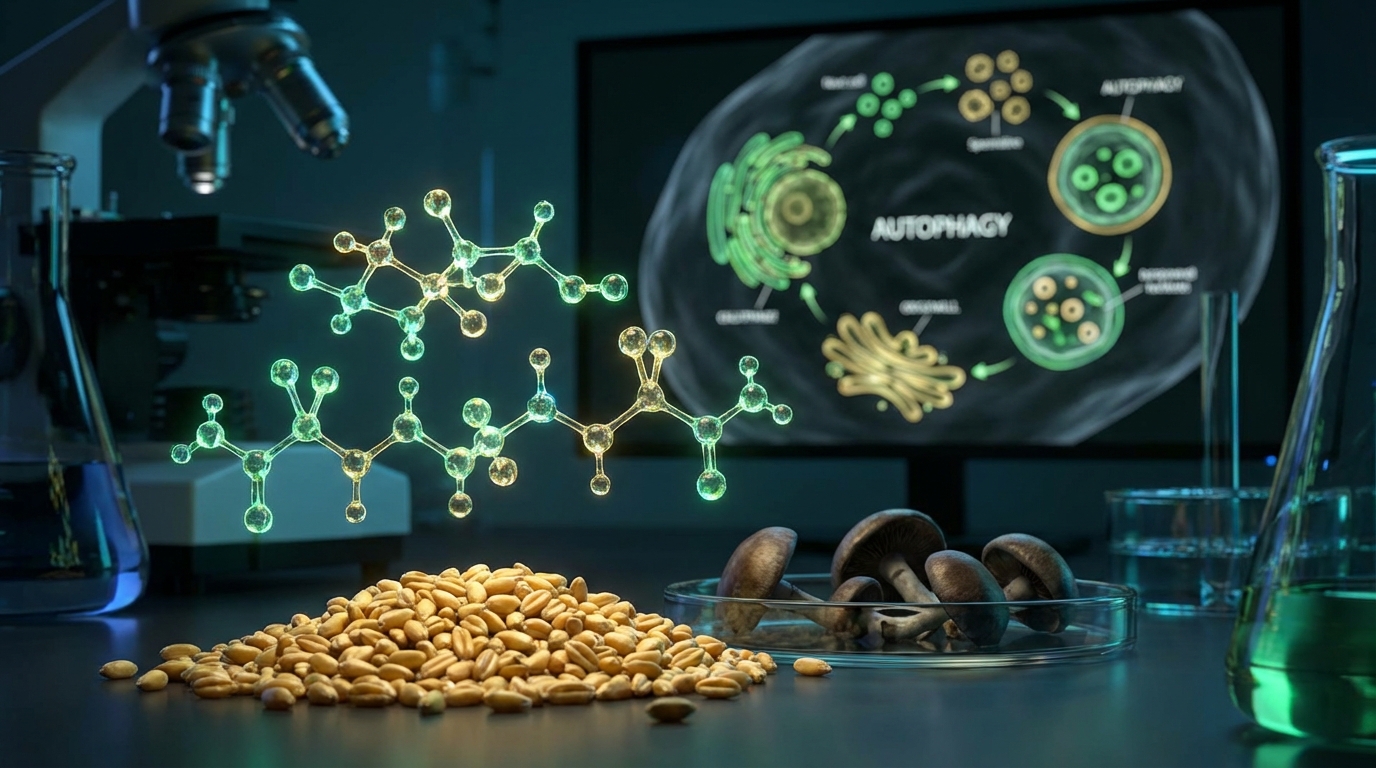
If you’ve been exploring the world of longevity supplements, you’ve likely come across NAD+ boosters, senolytics, and CoQ10. But there’s another compound quietly building a strong research base: spermidine. Found naturally in wheat germ, aged cheese, and mushrooms, spermidine is a polyamine that plays a critical role in one of the body’s most powerful self-renewal processes — autophagy.
In this guide, we’ll break down what spermidine is, what the science says about its anti-aging effects, how to get it from food and supplements, and what dosage the research currently supports.
What Is Spermidine?
Spermidine is a naturally occurring polyamine — a class of small molecules derived from the amino acid arginine. Alongside putrescine and spermine, it’s present in virtually every living cell and plays essential roles in DNA stability, protein synthesis, and cell growth.
The name might sound unusual, but spermidine is far from exotic. Your body produces it endogenously, and you consume it regularly in common foods. The challenge is that spermidine levels decline with age, paralleling the slowdown in cellular maintenance processes like autophagy that contribute to aging.
This natural decline has prompted researchers to ask: can restoring spermidine levels slow aging? The early evidence is surprisingly compelling.
The Autophagy Connection
The main reason spermidine has captured longevity researchers’ attention is its ability to induce autophagy — the cellular “self-cleaning” process where cells break down damaged proteins, dysfunctional organelles, and other debris for recycling.
Autophagy is essential for:
- Clearing out protein aggregates linked to neurodegenerative diseases
- Removing damaged mitochondria (mitophagy)
- Defending against pathogens and cancer cells
- Maintaining tissue quality as we age
Spermidine triggers autophagy by inhibiting a specific acetyltransferase enzyme (EP300), which sets off a signaling cascade that upregulates autophagy genes. This mechanism is distinct from caloric restriction and mTOR inhibition, though the downstream effects overlap significantly.
A landmark 2009 paper published in Nature Cell Biology demonstrated that spermidine extended lifespan in yeast, flies, worms, and human immune cells — all through autophagy activation. This cross-species effect was a powerful early signal that spermidine taps into a conserved longevity pathway.
If you’re curious about related pathways, our guide on how to activate mitophagy covers the overlapping mechanisms in detail.
Key Health Benefits of Spermidine
1. Cardiovascular Protection
One of the most replicated findings in spermidine research is its cardiovascular benefit. A large observational study published in Nature Medicine (2018) followed over 800 participants for 20 years and found that higher dietary spermidine intake was associated with lower all-cause mortality, largely driven by reduced cardiovascular deaths.
Mechanistically, spermidine appears to:
- Improve arterial elasticity by reducing stiffness in the aorta
- Lower blood pressure through eNOS activation
- Protect against atherosclerosis by reducing macrophage foam cell formation
Animal studies have shown that spermidine supplementation can reverse age-related cardiac dysfunction, restoring heart function in older mice to levels seen in younger animals.
2. Brain Health and Cognitive Protection
Autophagy dysfunction is implicated in Alzheimer’s and Parkinson’s disease — both involve the accumulation of misfolded proteins (amyloid-beta and alpha-synuclein, respectively). Spermidine’s autophagy-boosting action theoretically addresses this at the root level.
In a randomized controlled trial published in Cortex (2018), older adults with subjective cognitive decline who received spermidine-rich plant extract (from wheat germ) for 3 months showed significant improvements in memory performance compared to placebo — a striking result for a compound with a dietary source.
Rodent models consistently show that spermidine prevents or slows neurodegeneration when administered before or during the aging process.
3. Immune System Rejuvenation
The immune system undergoes a process called immunosenescence — a gradual decline in function with age. Aging immune cells accumulate and become less responsive to threats. Spermidine has been shown to enhance T-cell function and improve vaccine responses in older animals.
Research from the University of Innsbruck found that spermidine helped aged mice mount a stronger immune response, suggesting potential applications for improving vaccine efficacy in older adults.
4. Hair Growth and Skin Health
Spermidine has an interesting cosmetic dimension. A small randomized trial found that a spermidine-containing nutritional supplement significantly prolonged the hair follicle growth phase (anagen) compared to placebo. Participants also reported increased hair shaft diameter — a meaningful outcome in early hair loss.
For skin, spermidine’s promotion of cellular turnover and autophagy may support epidermal renewal, though clinical data here is less robust.
5. Liver Protection
Non-alcoholic fatty liver disease (NAFLD) is increasingly common and strongly age-related. In mouse models of NAFLD, spermidine supplementation reduced liver fat accumulation, inflammation, and fibrosis — all through autophagy-dependent mechanisms.
Natural Food Sources of Spermidine
Spermidine is found in a wide range of foods. The highest concentrations are in:
| Food | Spermidine Content (approx.) |
|---|---|
| Wheat germ | 243 nmol/g |
| Aged hard cheese (cheddar, parmesan) | 30–60 nmol/g |
| Mushrooms (shiitake, oyster) | 35–90 nmol/g |
| Soybeans/natto | 20–80 nmol/g |
| Peas and lentils | 25–40 nmol/g |
| Broccoli | 15–30 nmol/g |
| Chicken liver | 45 nmol/g |
A typical Western diet provides roughly 10–12 mg of spermidine per day. Traditional diets rich in fermented foods, legumes, and whole grains tend to be higher. The Okinawan and Mediterranean diets — both linked to longevity — are naturally higher in spermidine-containing foods.
Spermidine Supplements: What to Know
Because dietary spermidine varies widely and absorption may decline with age, oral supplements have become popular. Most commercial supplements use wheat germ extract standardized to a specific spermidine content, typically providing 1–5 mg of spermidine per capsule.
What to Look For in a Supplement
- Standardized extract: Look for wheat germ extract with a defined spermidine concentration (e.g., 1 mg per serving)
- Third-party tested: Choose brands with COA (certificate of analysis) to verify purity and potency
- Gluten-free options: If you’re gluten-sensitive, some brands offer a spermidine-rich extract that’s processed to remove gluten proteins
- No unnecessary fillers: Simple formulations are preferable
Some supplements combine spermidine with synergistic compounds like NMN, resveratrol, or quercetin. These stacks make sense mechanistically — autophagy and NAD+ pathways are complementary. See our guide on building a longevity supplement stack for beginners for framework on how to layer these compounds.
Spermidine Dosage: What the Research Suggests
There’s no established RDA (recommended daily allowance) for spermidine. Based on the available research:
- Observational studies: The range associated with longevity benefits in dietary studies is approximately 80–130 nmol/kg/day — achievable through diet
- Intervention studies: Most human trials have used 1–2.5 mg/day of supplemental spermidine from wheat germ extract
- Animal longevity studies: Dosing in mice used concentrations that scaled to roughly 2–5 mg/day in humans
A practical starting point for supplementation is 1 mg/day with food, increasing to 2–3 mg/day based on tolerance. There’s no strong evidence for higher doses providing added benefit in humans.
Timing: Spermidine can be taken any time of day. Some users prefer taking it during a fasting window to potentially enhance autophagy induction, though this hasn’t been specifically studied.
Safety and Side Effects
Spermidine has a strong safety profile. It’s a compound your body naturally produces and that you’ve been consuming in food your entire life. Human trials have not reported significant adverse effects at doses up to 5 mg/day.
Theoretical concerns include:
- Cancer risk: Polyamines are involved in cell growth, raising early concerns about cancer promotion. However, the research hasn’t borne this out — autophagy induction is generally anti-tumorigenic, and observational studies show neutral or protective effects on cancer risk. That said, individuals with active cancers should consult their oncologist before supplementing.
- Drug interactions: No known significant interactions have been identified, but those on immunosuppressants or cancer therapeutics should seek medical advice.
Pregnant and breastfeeding individuals should avoid supplemental spermidine due to insufficient safety data in these populations.
Combining Spermidine With Other Longevity Compounds
Spermidine works well alongside other evidence-based longevity interventions:
- NMN/NR: NAD+ boosters and autophagy inducers address complementary aspects of cellular aging. NAD+ is essential for sirtuin activity that supports mitochondrial health; spermidine clears damaged components. See our NMN vs NR comparison to choose the right NAD+ precursor.
- Fisetin: Both are autophagy-supportive with complementary senolytic activity
- Intermittent fasting: Fasting is one of the most powerful autophagy triggers — spermidine may amplify this effect
- Exercise: Physical activity induces autophagy in muscle tissue; spermidine may extend and support this process
The Bottom Line
Spermidine is one of the more compelling longevity compounds in the research pipeline — not because of hype, but because the evidence base spans multiple species, multiple disease models, and now early human trials. Its mechanism (autophagy induction) targets a fundamental aging process that’s genuinely important.
Key takeaways:
- Spermidine declines with age and is a powerful inducer of autophagy
- Observational data links higher dietary spermidine to reduced cardiovascular mortality and longer lifespan
- Early clinical trials support benefits for cognition, hair growth, and cardiac function
- Food sources include wheat germ, aged cheese, mushrooms, and legumes
- Supplemental doses of 1–3 mg/day appear safe and effective based on current evidence
If you’re building a longevity supplement stack, spermidine deserves serious consideration — especially if your diet is low in the foods that naturally supply it.
Frequently Asked Questions
Q: Is spermidine safe to take long-term? A: Based on current evidence, spermidine appears safe for long-term use. It’s a naturally occurring compound found in everyday foods, and human trials up to 3 months have shown no significant adverse effects. However, long-term controlled trials are still limited, so consult your healthcare provider.
Q: How long does it take for spermidine to work? A: In the cognition trial, improvements were seen at 3 months. For other outcomes like cardiovascular or hair benefits, some users report noticing changes within 2–3 months. Autophagy induction likely happens more quickly, but the downstream benefits accumulate over time.
Q: Can I get enough spermidine from food alone? A: If your diet is rich in wheat germ, legumes, mushrooms, and aged cheeses, you may be consuming meaningful amounts of spermidine. However, dietary levels are variable and absorption may decline with age, which is why some people choose to supplement.
Q: Does spermidine work like fasting? A: Spermidine shares autophagy induction as a common mechanism with fasting, but through a different molecular pathway. They’re complementary rather than identical, and combining them may provide additive benefits — though this hasn’t been formally tested.
Q: Should I cycle spermidine or take it daily? A: Current research doesn’t suggest a need to cycle spermidine. Most studies have used daily dosing. Unlike mTOR inhibitors (e.g., rapamycin) which are often used intermittently, spermidine’s gentler mechanism of action appears compatible with daily use.